 MemorizunLearn poems by heart
O, what a rogue and peasant slave am I
Alone after the players have left, Hamlet reproaches himself for his inaction and resolves to test the King's guilt with a play.
O what a rogue and peasant slave am I!
Is it not monstrous that this player here,
But in a fiction, in a dream of passion,
Could force his soul so to his own conceit
That from her working all his visage wan'd;
Tears in his eyes, distraction in's aspect,
A broken voice, and his whole function suiting
With forms to his conceit? And all for nothing!
For Hecuba?
What's Hecuba to him, or he to Hecuba,
That he should weep for her? What would he do,
Had he the motive and the cue for passion
That I have? He would drown the stage with tears
And cleave the general ear with horrid speech;
Make mad the guilty, and appal the free,
Confound the ignorant, and amaze indeed,
The very faculties of eyes and ears. Yet I,
A dull and muddy-mettled rascal, peak
Like John-a-dreams, unpregnant of my cause,
And can say nothing. No, not for a king
Upon whose property and most dear life
A damn'd defeat was made. Am I a coward?
Who calls me villain, breaks my pate across?
Plucks off my beard and blows it in my face?
Tweaks me by the nose, gives me the lie i' th' throat
As deep as to the lungs? Who does me this?
Ha! 'Swounds, I should take it: for it cannot be
But I am pigeon-liver'd, and lack gall
To make oppression bitter, or ere this
I should have fatted all the region kites
With this slave's offal. Bloody, bawdy villain!
Remorseless, treacherous, lecherous, kindless villain!
Oh vengeance!
Why, what an ass am I! This is most brave,
That I, the son of a dear father murder'd,
Prompted to my revenge by heaven and hell,
Must, like a whore, unpack my heart with words
And fall a-cursing like a very drab,
A scullion! Fie upon't! Foh!
About, my brain! I have heard
That guilty creatures sitting at a play,
Have by the very cunning of the scene,
Been struck so to the soul that presently
They have proclaim'd their malefactions.
For murder, though it have no tongue, will speak
With most miraculous organ. I'll have these players
Play something like the murder of my father
Before mine uncle. I'll observe his looks;
I'll tent him to the quick. If he but blench,
I know my course. The spirit that I have seen
May be the devil, and the devil hath power
T'assume a pleasing shape, yea, and perhaps
Out of my weakness and my melancholy,
As he is very potent with such spirits,
Abuses me to damn me. I'll have grounds
More relative than this. The play's the thing
Wherein I'll catch the conscience of the King.
Quick facts about “O, what a rogue and peasant slave am I”
- Author
- William Shakespeare
- Year
- 1600
- From
- Hamlet, Act II, Scene ii
- First line
- O what a rogue and peasant slave am I!
- Length
- 57 lines
- Time to learn
- about 29 minutes
Questions about “O, what a rogue and peasant slave am I”
Who wrote “O, what a rogue and peasant slave am I”?
“O, what a rogue and peasant slave am I” was written by William Shakespeare in 1600 and comes from Hamlet, Act II, Scene ii.
What is the first line of “O, what a rogue and peasant slave am I”?
The first line of “O, what a rogue and peasant slave am I” is: “O what a rogue and peasant slave am I!”
How long is “O, what a rogue and peasant slave am I”?
“O, what a rogue and peasant slave am I” is 57 lines long.
How long does it take to memorize “O, what a rogue and peasant slave am I”?
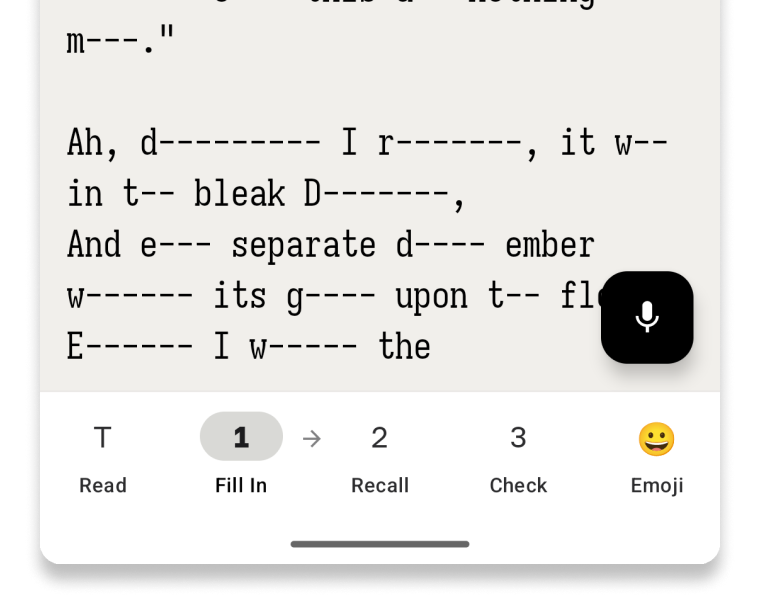
Plan on about 29 minutes in the Memorizun trainer, which hides words and letters step by step so you recall the text instead of rereading it. A few short sessions on separate days help it stick.
What is the best way to memorize “O, what a rogue and peasant slave am I”?
Read it aloud once or twice, then use the trainer to hide more of the text each round until you can say it without looking. Review it again the next day.